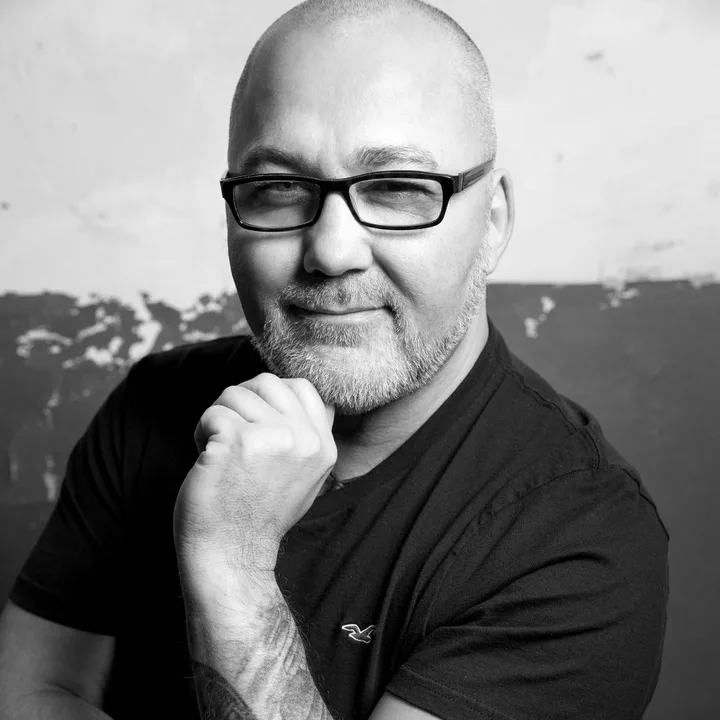
Mathias Fiedler
aka Slippy Beats / DJ MAUI
Music has always been my passion. Technology somehow too. And sometimes the best ideas come up exactly when the two meet.
I am a DJ, music producer, sound designer and mix engineer. And for a while now I have been getting deeper into software development again. But more on that later.
My musical journey began in the early 90s. I have been producing electronic music since 1994, first with Cubase, later with Logic Pro and since 2015 mainly with Ableton Live. Musically I have always been somewhere between house, dance and pop.
Some of you may still know me from the Avantgarde hit “Get Down” from 1998 or from various club and music projects I was involved in over the years. Releases came out on Dance Of Toads, among others, and of course on Beatport.
For more than 27 years I played actively as a DJ, spent countless nights behind the decks and experienced pretty much everything DJ life has to offer. Today I only play occasionally. Not because music means less to me, but because my interests have simply shifted a little over time.
These days my heart beats above all for music production, sound design and everything technical behind it.
Musician, yes. Composer? Not really.
I have to confess something here: I was never the great songwriter or classic composer.
My strengths lie more in developing sounds, shaping arrangements, producing music and turning it into a good mix in the end. I hear pretty quickly when something does not work musically or a harmony does not fit. But quickly playing the right chords on the keyboard myself? That has always been a completely different story for me.
For things like that, over the years I preferred to work with people who are much better at it than I am.
And exactly this fact would later play a pretty important role.
From a Counter-Strike server to my own software
Because besides music there has always been a second passion: computers and technology.
A lot of it actually started with Counter-Strike. Anyone who ran their own game servers back then knows that sooner or later you inevitably had to deal with server administration, configurations, scripts and all kinds of technical problems.
That is how I dived deeper and deeper into the IT world.
Later I worked professionally in IT for several years and, among other things, focused on helping companies migrate their on-premises IT infrastructure to the cloud.
I also kept coming back to programming. Still, I would not necessarily call myself a classic software developer. I am more someone who has an idea, wants to solve a problem and then keeps working on it until it works.
Sometimes that just takes a little longer. ;-)
And then artificial intelligence came into play.
Suddenly things became possible that I could imagine before, but could never have programmed myself.
And that is really where the story of musaik began.
AI makes a lot possible. But not on its own.
At this point I also want to be completely open about a topic that played a pretty big role in developing musaik: artificial intelligence.
Yes, a large part of musaik was indeed created with the help of AI. And I have no problem at all saying so. Quite the opposite.
Without today’s possibilities of AI-assisted programming I could never have realised this project in this form. I am fully aware of that.
I am not a professional software developer and would never claim to be one. What I do bring, though, is many years of experience with complex technical systems, a good understanding of processes and how they connect, and of course plenty of knowledge from music production.
And exactly this combination helped me enormously during development.
Because anyone who believes you just give an AI a prompt and out comes finished software like musaik is quite mistaken. ;-)
The real challenge is knowing in the first place what you want to achieve, which technical options exist and how the individual components have to work together sensibly.
You have to translate ideas into working concepts, think processes through, check results, spot errors and make decisions again and again. And sometimes you have to explain to the AI quite clearly why its supposedly brilliant solution does not work at all in practice.
With musaik in particular there were countless situations in which something worked technically but made no sense at all musically.
An AI can write code. But it does not automatically know what makes a good DJ transition, why a certain break matters musically or why two tracks simply do not work together despite identical BPM and a matching key.
I had to bring in that knowledge, the ideas and the requirements myself. And of course try out a lot, test, throw away and start over again.
By the way, I learned an incredible amount myself along the way. About software architecture, algorithms and technical connections I had never dealt with in such depth before.
For me, AI is therefore neither a miracle cure nor something whose use you would have to keep quiet about.
AI enabled me to turn my ideas into working software. My experience helped me to use these possibilities sensibly.
And that is exactly what I find so fascinating about this development: today people can create things for which they would simply have lacked the technical skills or the financial means in the past.
Not because AI can suddenly do everything, but because it helps to push your own limits quite a bit further.
For me, musaik is the best example of that.
And to be completely honest? I am sometimes surprised myself at what this originally small idea has turned into.
How a small idea became musaik
The original idea behind musaik was actually pretty simple.
I wanted to develop software that helps me edit music in a different way and put it back together anew. A tool that does not just look at individual audio files, but ideally also understands how a song is built musically.
Where does a break begin? When does the next build-up start? Where is the drop? Which elements fit together harmonically and rhythmically?
And above all: how can this information be used to create something new from existing tracks?
In the beginning, musaik was really only meant for myself.
But as is often the case with projects like this: you show your first results to a few friends, discuss them, get new ideas and at some point realise that the originally small application could become something much bigger.
That is exactly what happened.
The Mashup Mode – and the thing about song structure
It became clear fairly quickly that the Mashup Mode should be able to do much more than simply play two tracks in sync.
My goal was for musaik to detect the musical structure of a song as reliably as possible and to use this information to rearrange tracks intelligently.
At first that does not sound that complicated.
But it is. Believe me. ;-)
I spent an incredible amount of time researching, trying out different approaches, analysing music and comparing results over and over again.
Because music often follows certain structures, but by no means always the same rules. What works wonderfully for a classic house track can look completely different for a pop song.
Automatically detecting and evaluating song structures was by far one of the biggest challenges in developing musaik.
And I want to be completely open about this too: the system is still not perfect today.
But that is exactly why I decided to take a different path.
Not everything has to be a black box
Instead of hiding all of the software’s decisions behind some secret algorithms, I wanted to create a system in which users can understand how certain results come about.
The rulebook musaik works with is therefore open to view and can be adapted and optimised to your own needs.
Because why should every DJ or producer have to work with exactly the same rules?
One prefers long, harmonic transitions. Another wants to get to the next drop as quickly as possible. And someone else again has very personal ideas of how a mashup should be built.
musaik is meant to support these different ways of working instead of squeezing them into a rigid concept.
And this is where the community comes in.
Through exchange, feedback and the possibility to share experiences and optimisations with each other, we can improve the results step by step.
Because I believe that together we can achieve much more than if I try alone in my studio to find the perfect solution for every musical situation.
One mode suddenly became three
At some point during development a pretty obvious thought occurred to me:
If the software already knows so much about music anyway, why should it only be able to create mashups?
After all, sometimes you do not want to build a completely new track from several songs at all.
Sometimes you just want to edit an existing track. Extend an intro, shorten a break, choose a different entry point or optimise the arrangement for the next DJ gig.
So the Edit Mode was born.
A workspace of its own for editing and rearranging tracks without having to create a complete mashup right away.
And then, of course, came the next idea.
Why use several programs when many of these functions can be combined sensibly?
Especially in DJ mixing it can be enormously helpful if software not only knows BPM and key, but also understands at which points of a song a transition could make musical sense.
So musaik also became a tool for creating DJ mixes.
The DJ Mix Mode was born.
And with that, the original idea had finally taken on a life of its own.
A small personal project had turned into a pretty extensive piece of music software that today combines three different ways of working:
- Mashup Mode: analyse tracks, detect musical structures and develop new arrangements and mashups from them.
- Edit Mode: edit existing songs, restructure them and optimise them for your own purpose.
- DJ Mix Mode: create complete DJ mixes, using the musical analysis for fitting transitions and a coherent arrangement.
Over time, a built-in synthesizer, instrument tracks with a chord lane and harmonizer, a sampler and, if you like, AI ideas for melodies and phrases were added.
The nice thing is that all three areas are built on a shared technical foundation and can benefit from each other.
Is musaik finished? Of course not.
Anyone who has ever developed software themselves probably knows this.
You think a feature is finished, and five minutes later you think of something you absolutely could still improve.
That is how it constantly goes for me with musaik.
And the more intensively I explore the possibilities, the more ideas come up.
At the same time I want to stay realistic: not every automatic analysis will always be right. Not every transition will be perfect straight away. And there are certainly many things we can still do better.
But that is exactly what makes this project so exciting for me.
musaik is not meant to be a rigid product where at some point someone decides that everything is now finished.
Rather, I want a tool that grows with its users. Software that keeps evolving, stays open to new ideas and where the community can really make a difference.
That is why I welcome any constructive feedback, suggestions for improvement, new ideas and of course hints when something does not yet work the way it should.
Because in the end we are developing the software for people who enjoy music just as much as I do.
And who knows what ideas we will still come up with together?
This would not have been possible without you
Even though I have worked on musaik myself for countless hours, the project would not be where it is today without the support of some great people.
A big thank you goes to Jay Frog and Clark Wohlert, who supported me during development with their ideas, experience, honest feedback and many discussions.
Very special thanks go to Chris-Oliver Götzki, who actively supported me in developing the harmonizer and contributed valuable musical and technical knowledge.
And then, of course, there is my wife.
For quite a long time she had to put up with me disappearing into my studio again in the evening after a completely normal working day to improve “just one more little thing” on musaik.
That little thing regularly turned into several hours.
And a few weeks of development time ... well, let’s not talk about that. ;-)
Thank you for your patience, your understanding and for simply letting me do my thing. ❤️
And now it’s your turn!
I hope musaik gives you as much joy as developing it gave me.
Maybe the software helps you realise new creative ideas. Maybe you discover possibilities you would never have thought of before. Or maybe you simply save a lot of time on things that used to be pretty tedious.
If that works out, all the work has already been worth it for me.
I am looking forward to developing musaik further together with you.
Keep making music. Stay creative. And have fun!
Mathias
Slippy Beats / DJ MAUI